Back again folks, with another one of these “Normie Q&A” posts. God, I need a better name for one of these. If you have any suggestions, feel free to let me know.
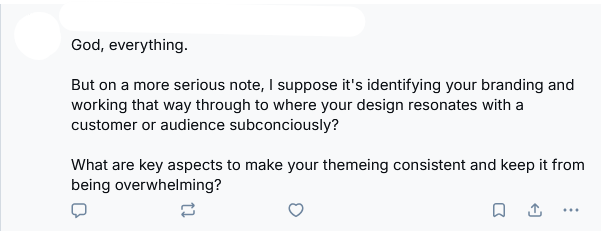
“God, everything. But on a more serious note, I suppose it's identifying your branding and working that way through to where your design resonates with a customer or audience subconciously? What are key aspects to make your themeing consistent and keep it from being overwhelming?”
But anyway, this one piqued my interest, since it’s a lot less specific than the last two we’ve looked at. This one is more generalistic. Let’s take a look at it
So we’re talking about consistency. And when you’re building a brand, as with most things it's way easier to make your brand consistent if you make the right preparations. Basically: How are you going to sound consistent when you don’t know what you’re aiming for? The answer is you don’t. So let’s get prepared with another list.
Four things you gotta have in order so your brand and all your communication is consistent.
Who Are You Talking To?
Before you decide what you’re gonna say, you need to decide who you’re talking to. And no, before you say anything, you can’t say “my audience is everyone”. Even if you’re selling water - something everyone on the planet needs - you need to have a target audience in mind if you want to effectively communicate your brand and your ideas. What’s the saying, If you try to be all things to all people, you won’t be anything to anybody. Something like that.
Do you have an Audience Persona? If not, you need one. Because without it, you’re not talking to anyone, you’re just talking. An Audience Persona is basically the one guy you’re addressing whenever you write or make anything to do with your brand. It’s all for this one guy. Your perfect target audience.
It sounds silly, I know, but you gotta do it. You gotta make up a guy to sell your wares to. It’ll help you drill down and properly understand who you’re selling to, what they want, what they need and their pain points. In turn, this will help you save time and money on your marketing, build stronger relationships with customers and, let’s not forget the point of the post this time, be more consistent.
And when I say make up a dude, you gotta fully flesh out this made up dude. You need to know things like:
Age, Occupation, Education Level, Location, Interests, Attitudes, Motivations, Needs & Wants, Struggles, Goals. All these things will help you build a robust person you can communicate with in all of your brand communication.
And give ‘em a name as well. That one’s just for funsies.
Once you know who you’re talking to, you need to focus on the next step. And that is…
How are you talking?
If you’ve read any of these other write ups, or any of my LinkedIn posts or had any conversation with me in a business setting, you’ll notice that it’s all, like, the same. I sound the same, I read the same, and you can tell when something’s come from me, you know? It’s this “semi-casual but still definitely knows what they’re talking about” with a dash of “incredibly online” and a hint of “referencing pop-culture in a cool and discreet way”.
And that’s not by accident (I mean, a small part of it is, I am naturally charismatic and charming). Long ago I made the decision that this is how I was going to communicate to you guys. I don’t want to bog you down with jargon, but I want to make it clear I know what I’m saying. I want you to be comfortable, I want to seem relatable, because we’re all on the same level here.
I put that all in writing, in a document called My Brand Voice. It’s a set of rules for how I communicate. What I will say, what I won’t say, how I phrase things and I know it all sounds very corporate and robotic. But, again, look at this. Look at how I write, how I talk. I don’t sound like a robot, I just sound like a guy. All the brand voice document does is ensure that whenever someone sees something you’ve made, they can tell it’s from you.
Easiest place to start is defining what your brand isn’t, and to move out from there. Like, are you not casual, well then you want to be formal, and what does that mean? How does that communicate?
And this is about more than just what words you use, of course. I’m a visuals expert. If you want words, go over to Sarah (sarahdobbs.com). Your brand voice incorporates the forms your communication takes too. Are you a long, text post brand? Or a vlog style brand? A tiktok brand? It’s all in the brand voice.
And no, you’re not everything. Remember what we said about doing everything? It’s doing nothing.
Alright, next up, you’re done deciding who and how. Now onto what. And of course, by that I mean
What do you care about?
Yeah, before you can actually start communicating properly with your audience, you need to look inward. You’ve gotten to know your audience, now it’s time to get to know yourself. I’m talking about three distinct things you gotta have in place. These are the things you’re talking about and the tools you’re using to solve the problems you identified in your audience.
Vision
This is what the brand hopes to achieve long-term. This is your big, pie-in-the-sky massive idea about how you’re gonna change the world with your brand. Some people literally call this the dream. So you gotta have this in place first and foremost, to know what you’re working towards.
Mission
This is how you’re gonna achieve the vision. What you do differently to every other person doing the same thing. The guiding force that leads you to success. The mission is grounded in the brand’s value proposition, grabbing your target audience from before and telling them the benefits you’ll give them.
Values
And these are the things that are important to you as a person and a brand. What attributes would you want in your ideal employee? What attitude do you have that other people who do your thing do not? What makes you tick?
Once you have all of this in place, you’re finally in the place where you can start to co- haha! Got you! That was a test! There’s one more piece! I said four things and we’re only on three!
What are you wearing?
This is the big one, the Style Guide. This is kind of a visual version of the Brand Voice, but it’s more rigid and rules-oriented than the others. It should contain:
Your Logos, in all of their various lockups and variants, complete with do’s and don’ts.
Your colour codes, and how they do and don’t go together
Your fonts and typefaces, along with what weights you need them and what font you use for each bit of text.
Any resources or stock photos you might need
Social Media Post Templates
This is everything. The instruction manual to your brand’s visuals. And it is so important. Because the key question was “how do I feel consistent” and this is how. By looking consistent. It’s simple as that, truly. Everything we’ve spoken about today all boils down to that. If you want to feel consistent, you have to look consistent. You have to sound consistent.
You have to be consistent.

If you need help getting all of these ducks in a row, give me a shout for the visuals, and I know I shouted her out before but I’ll do it again: my friend Sarah (sarahdobbs.com) is your go to for the written word.